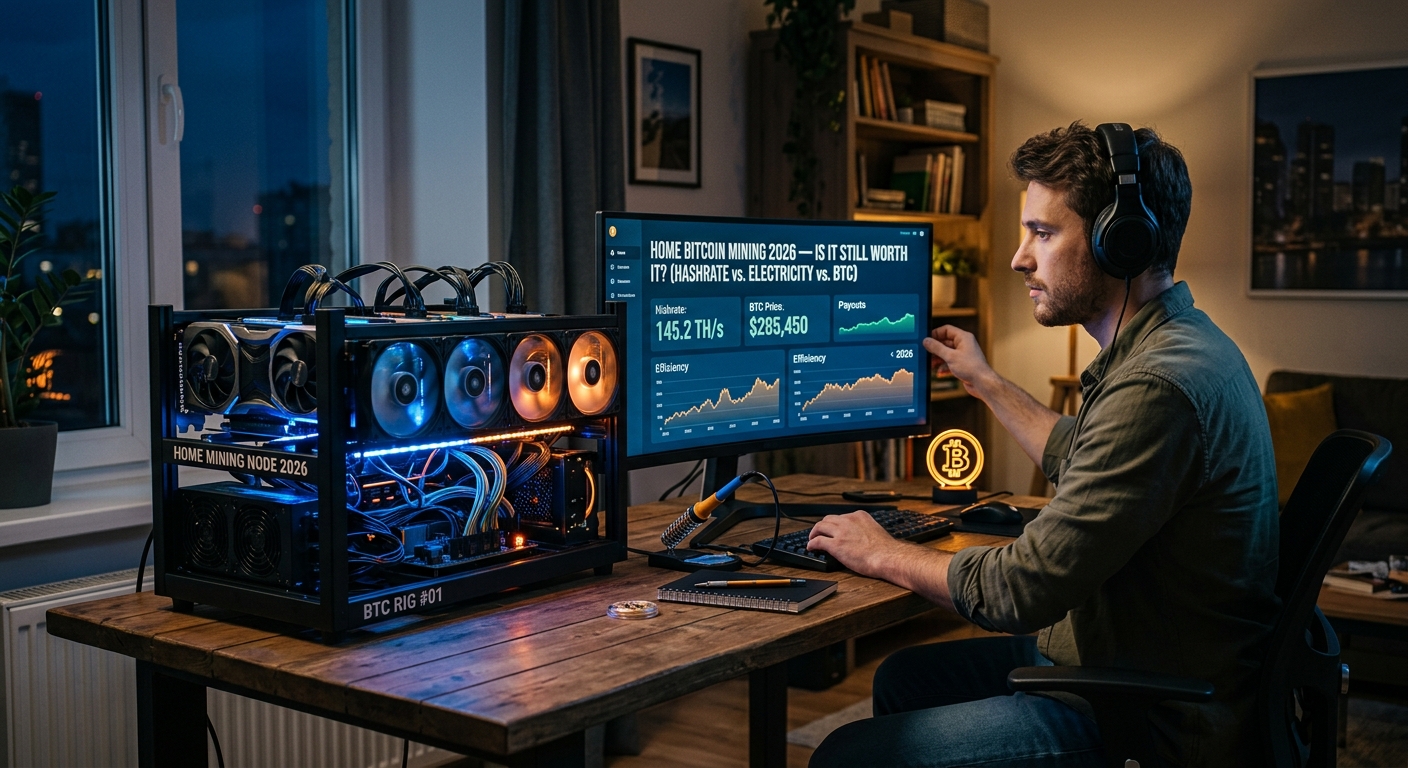
The rigs are still running. In basements, garages, and spare rooms across the country, home miners are keeping their machines online despite years of predictions that the hobby would be priced out of existence. The question has never really been whether home mining is possible. It is whether the numbers actually work in your specific situation, with your specific electricity rate and your specific hardware budget.
Your electricity rate is the single variable that determines whether home mining earns money or bleeds it.
- Current-generation ASIC hardware is significantly more efficient than machines from three years ago, but upfront costs and depreciation remain steep.
- Pool mining is the only practical path for most home operations, given how unlikely a solo miner is to find a block independently.
- Honest profitability projections must account for hardware depreciation, tax liability on mined income, and cooling costs, not just the raw electricity number.
The State of Home Mining After the Latest Halving
Bitcoin’s most recent halving cut the block reward to 1.5625 BTC. At current price levels, that figure still supports profitable operations, but the margin for error has tightened considerably. Industrial mining operations running at scale have claimed an increasing share of the global hash rate, pushing difficulty to record levels. Home miners are competing against facilities with purpose-built infrastructure and negotiated power contracts.
That does not mean home mining is over. The Bitcoin network is open, permissionless, and still rewards anyone who can mine profitably. What it does mean is that the era of plugging in any machine and watching returns roll in is firmly behind us. Profitability now depends on aligning several conditions simultaneously, and those conditions are worth examining one by one before spending a dollar on hardware.
Hardware Choices That Define Your Ceiling
Why ASICs Dominate Every Serious Setup
Application-specific integrated circuits are built to do one thing: compute SHA-256 hashes as fast and efficiently as possible. In 2026, the leading units are achieving efficiency ratings in the range of 15 to 18 joules per terahash. Compare that to machines from 2021 or 2022 running at 30 to 40 joules per terahash, and the efficiency gain becomes obvious. That gap translates directly into lower electricity costs per unit of work performed.
The machines driving real returns today sit in the Antminer S21 series and the WhatsMiner M60 and M63 range. New units cost between $2,500 and $6,000 depending on hash rate tier and model. Used hardware is cheaper upfront, but older-generation machines consume more power and generate more heat per terahash, which chips away at monthly margins. Before committing to any purchase, work through a proper Bitcoin mining guide to understand exactly how hashing, difficulty adjustment, and block confirmation interact, because those mechanics shape which hardware specifications actually matter for your bottom line.
GPU Mining and Bitcoin Are a Mismatch
Graphics cards are not viable for Bitcoin mining in 2026. ASICs outperform them by many orders of magnitude on SHA-256. GPUs still have use cases in certain altcoin ecosystems, but anyone asking whether they can mine Bitcoin with their gaming rig is working from outdated information. For Bitcoin specifically, ASICs are the only practical tool.
Electricity: The Cost That Makes or Breaks the Math
Find your electricity bill before you do anything else. Look for the kilowatt-hour price. According to the U.S. Energy Information Administration’s monthly electricity data, the average residential rate in the United States sits around 16 to 17 cents per kilowatt-hour in recent reporting periods. Regional variation is significant, with some northeastern and west coast states pushing past 20 cents while parts of the midwest and south come in below 12.
At 16 cents per kilowatt-hour, a 3,500-watt ASIC running 24 hours a day costs roughly $134 in electricity alone. That is more than $4,000 per month. For that cost to make sense, your Bitcoin earnings need to comfortably clear that threshold. At current difficulty and price levels, only the most efficient hardware running in the best electricity rate zones can consistently achieve that.
At 6 to 8 cents per kilowatt-hour, the same machine generates a meaningfully different picture. Home miners with access to cheap power, whether through rural cooperative pricing, off-peak rate agreements, or excess solar capacity, are the ones who have survived the post-halving difficulty climb. The electricity rate is not just a variable in the formula. For most home miners, it is the formula.
Heat management adds a hidden cost that many projections overlook. A high-wattage ASIC in a confined space raises ambient temperature fast. If you are running air conditioning to compensate during warm months, that electricity usage needs to go into your effective cost calculation alongside the miner’s own draw.
Pool Mining vs. Solo Mining: A Numbers Problem
Solo mining Bitcoin in 2026 is, for most home miners, a statistical fantasy. With the global hash rate where it stands, a home operation contributing one or two petahashes per second would statistically need centuries to find a block independently. That is not a business model. It is a lottery ticket with very long odds.
Pool mining changes the equation by aggregating hash rate from many participants. The pool collectively finds blocks at a much faster rate, and earnings are distributed based on each miner’s proportional contribution. Fees generally run between 1% and 2% of earnings. That is a reasonable cost for consistent, predictable payouts rather than unpredictable windfalls.
The major pools in 2026 include Foundry USA, Antpool, ViaBTC, and F2Pool. Each has its own fee structure and payout model. Pay-per-share models pay for every valid share submitted, regardless of whether the pool wins a block during that period. Full pay-per-share models add estimated transaction fees to the calculation. Proportional models pay only when the pool finds a block and split the reward based on shares submitted during that round. Understanding which payout model aligns with your risk tolerance and cash flow expectations matters before you point your miner at a pool address.
Setting Up a Home Operation the Right Way
ASIC miners are loud. A single high-end unit can hit 75 decibels or more, comparable to a running lawnmower in an enclosed space. Placing one in a living area is not a sustainable arrangement. A garage, basement, utility room, or outbuilding works far better. Noise isolation through enclosures or simple foam lining can reduce the impact on the rest of the space.
Electrical infrastructure is not optional to cut corners on. High-wattage ASICs draw serious amperage and need dedicated circuits. Have a licensed electrician assess your panel capacity and run dedicated wiring for the hardware. An overloaded circuit is a fire hazard, not just a nuisance, and insurance complications from DIY electrical work are not worth the saved cost.
Ventilation needs deliberate planning. ASICs pull in cool air and exhaust hot air at high volume. Without a clear airflow path, heat accumulates and forces the machine to throttle performance or, worse, sustain chip damage. Even a basic exhaust duct routed through an exterior wall can keep temperatures in a workable range and extend hardware lifespan meaningfully.
Internet connectivity for mining does not require high bandwidth. The mining protocol communicates small packets. A stable, modest broadband connection is sufficient. Stability is what matters. A connection that drops repeatedly costs you shares and, over time, earnings. A wired Ethernet connection to the miner is far more reliable than relying on a WiFi signal.
Running Honest Profitability Projections
Free online mining calculators like WhatToMine and CryptoCompare let you input your hardware specs and electricity rate to get a revenue estimate based on current difficulty and Bitcoin price. Use them. Then run the same calculation with Bitcoin’s price 25% lower. That downside scenario is the one that tends to catch home miners unprepared.
Hardware depreciation is a real cost that standard calculators ignore entirely. An ASIC purchased today will be worth considerably less in 18 to 24 months as newer, more efficient models reach the market. If your machine takes 20 months to pay itself off in mining revenue, and it has depreciated by 40% over that period, the actual return on your capital is thinner than the headline revenue number suggests.
Tax treatment of mining income is jurisdiction-dependent. In the United States and many other countries, mined Bitcoin is treated as ordinary income at its fair market value on the day it is received. That liability does not wait for you to sell the coin. Build it into your projections from the beginning, because the tax bill can easily turn a nominally profitable month into a losing one once the full picture is calculated.
Whether 2026 Home Mining Works for You Specifically
Home mining in 2026 works for the right operator in the right conditions. Electricity below 8 cents per kilowatt-hour is the most powerful advantage available. Efficient, current-generation hardware is next. A proper physical setup with clean ventilation and dedicated wiring keeps that hardware alive long enough to return the investment. And realistic projections that include depreciation, taxes, and cooling costs prevent the unpleasant surprises that kill otherwise viable operations.
If your electricity rate is above 12 cents per kilowatt-hour and you are starting from scratch on hardware, the numbers are genuinely difficult to make work at current difficulty levels. That is not a permanent verdict. Bitcoin price movement and the next halving cycle will shift the math again. But for right now, an honest read of the data points toward caution for high-rate regions.
Those with cheap power, efficient hardware, and a realistic understanding of the full cost picture are the home miners with a legitimate shot at consistent returns. The path is narrower than it was a few years ago. It is still a real path. The key is knowing your numbers before you spend anything, not after.

No responses yet