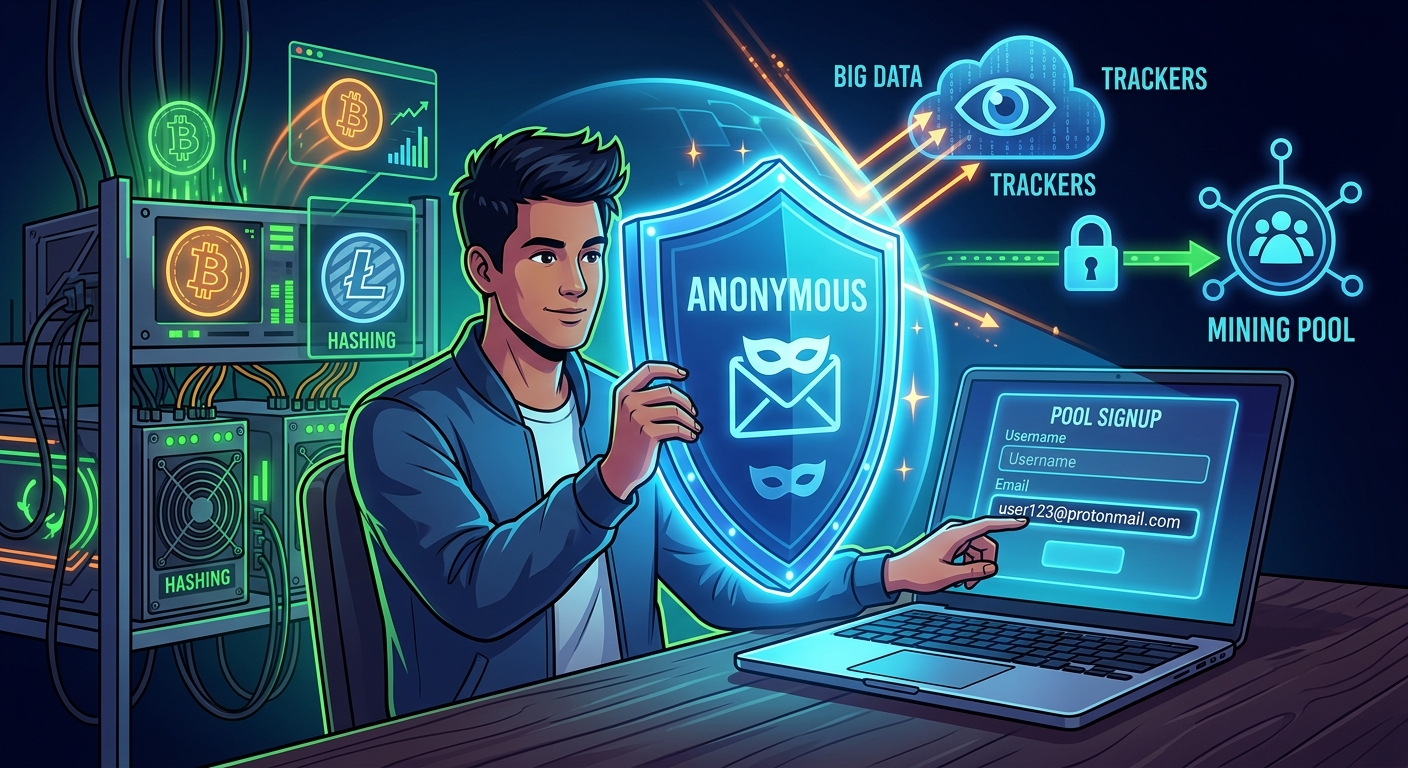
Mining pools are the backbone of most home operations in 2026. You configure your rig, point it at a pool address, and watch the hashrate climb. But before any of that happens, there is a registration screen sitting between you and your first share. It asks for your email address. Most new miners type in their main inbox without a second thought. That one small decision can mean months of spam, targeted phishing, and security headaches you never planned for.
Miner’s Privacy Snapshot
- Pool registrations expose your email to spam, phishing campaigns, and potential data breaches outside your control
- Using a throwaway address for pool accounts keeps your real inbox clean and your identity harder to trace
- Phishing attacks on miners often begin with contact details leaked from pool databases
- Two-factor authentication and strong unique passwords are essential alongside any email privacy strategy
- Good email habits at sign-up connect directly to safer wallet and payout management over the long term
Why Mining Pool Registrations Are a Privacy Minefield
Many independent mining pools run on lean infrastructure with small teams. Security budgets at smaller operations are often thin. Regular audits and penetration testing cost money that not every pool operator spends. That means your registration data, including your email address, sits in databases that may never receive the hardening they need.
This is not a theoretical concern. Pool operators have faced credential leaks before, and the consequences for affected users are real. When registration data gets exposed, attackers do not just send generic spam. They use your email address to craft targeted messages that reference your mining activity. They know you mine crypto. They know you have a wallet worth protecting. That context makes you a far more valuable phishing target than a random address pulled from a generic breach dump.
Even when a pool never suffers a breach, your address ends up on promotional lists. Some pools have commercial partnerships with hardware vendors, cloud hosting services, and mining software providers. Data-sharing clauses get buried in terms of service documents most users never read. One pool registration can quietly become five newsletters and a stream of promotional emails within weeks.
What Actually Happens to Your Address After You Register
Most pool sign-up flows are straightforward. You enter a username, an email address, and a password. Some pools require email verification before your account activates. After that, your address lives in their system indefinitely, tied to your mining identity.
Pool operators use that address for legitimate purposes: payout confirmations, threshold alerts, security notices, and maintenance announcements. But it also powers their marketing. If the pool is acquired, merges with a competitor, or simply shuts down, your registration data follows whatever path their servers take.
Some pools display usernames or emails publicly on leaderboards and referral dashboards unless you manually opt out. New users often miss those visibility settings entirely during the excitement of getting their first rig pointed at a pool. A publicly visible address tied to a known mining account is an open invitation for targeted attacks.
CISA has documented phishing risks in detail, noting that attackers increasingly rely on contextual lures rather than generic bait. Knowing a target mines cryptocurrency gives an attacker a powerful hook for a fake email about a suspended payout or a required account verification.
Email Strategies Compared: What Works Best for Pool Accounts
Email Approach Options for Mining Pool Account Sign-Ups
| Email Type | Privacy Risk | Inbox Clutter | Account Recovery | Best Use Case |
|---|---|---|---|---|
| Personal primary email | High | High | Easy | Not recommended |
| Dedicated mining email | Medium | Contained | Easy | Serious miners managing multiple pools long-term |
| Burner / disposable address | Low | None | Limited (plan ahead) | Sign-ups, pool testing, low-stakes accounts |
| Alias forwarding service | Low to medium | Manageable | Good | Long-term accounts needing real forwarding |
Protecting Your Contact Details from the Start
The cleanest option for most home miners is a throwaway address at registration. A burner email gives you a temporary address you can use to verify your account, receive your welcome message, and activate your pool dashboard without tying the registration to your real identity.
A few things to keep in mind before taking this approach:
- Verify your account immediately after sign-up, because some temporary addresses expire within minutes to hours
- Save your pool login credentials somewhere secure before the inbox disappears, since password reset emails will have nowhere to land once the address is gone
- Use this approach for pools you are testing or treating as secondary, rather than for a primary pool where you need reliable long-term access
- Consider an alias forwarding service for pools you plan to use for months, since those give you recovery options while still hiding your real address from the pool’s database
The goal is to break the link between your real identity and your mining activity. That separation protects you not just from spam but from social engineering attempts that rely on knowing who you are and what coins you mine.
Walking Through a Safe Pool Registration
Most pools follow the same registration pattern, whether you are signing up for a Bitcoin pool, an Ethereum Classic pool, or any proof-of-work network active in 2026. The steps below apply broadly.
Generate your throwaway or dedicated email address before opening the pool’s sign-up page. Do not let your browser autofill your real address by habit. Choose a username that does not tie back to your real name, your city, or any other accounts you run online. Mining usernames are sometimes visible to other pool members and can appear in public stats dashboards.
Use a strong unique password that you do not reuse at any other service. A password manager handles this without any extra effort on your part. Once your account is active, head straight into the security settings. Enable two-factor authentication before you do anything else. Most established pools now support authenticator apps, which are far preferable to SMS-based codes. Check your visibility settings and confirm your username and hashrate stats are set to private unless you have a specific reason to share them publicly.
Two-Factor Authentication and Why It Matters Alongside Email Privacy
Email hygiene addresses one risk vector. But even a perfectly isolated throwaway address does nothing if your pool password leaks and your account has no second layer of protection standing between an attacker and your payout settings.
Two-factor authentication means a malicious actor needs both your password and physical access to your authentication device to get inside. Most major pools now support this. Smaller or newer pools sometimes lag behind on implementing it. If a pool does not offer 2FA at all, that is worth weighing seriously before you commit to mining there.
The combination of a private registration address and a strong 2FA setup means that even if the pool suffers a breach, your account is meaningfully harder to hijack and your real identity remains disconnected from the leaked data.
Wallet Security and the Full Chain of Mining Identity
Your email address is one piece of a larger identity chain. The habits you build around account security at the pool level carry over directly to how you manage your wallet and payouts.
Think about the full picture. You mine shares to a pool. The pool pays out to a wallet address you control. If your pool account gets compromised, an attacker can change the payout address and redirect your earnings. That is a direct financial loss, not just an inconvenience.
The same discipline that goes into protecting your registration email applies across every layer of this chain:
- Use a hardware wallet or a self-custody address for pool payouts rather than an exchange deposit address that can shift without warning
- Never store your wallet seed phrase on any device connected to the internet, regardless of how convenient it seems
- Treat any email claiming to come from a pool with skepticism, especially if it asks you to log in or update a setting via a link in the message body
- Periodically log into your pool dashboard and confirm your payout wallet address has not been changed without your knowledge
Building the Habits That Keep Your Mining Identity Clean
Home mining has become more accessible than at almost any point in crypto’s history. That accessibility has also attracted more actors who specifically target the mining community. Phishing kits built around crypto miners circulate widely. Data leaked from smaller pools feeds targeted attack campaigns. The miners who mostly avoid this trouble are not running expensive security suites or doing anything technically advanced.
They are just careful at the moment of sign-up. They use a throwaway address for pool registrations. They pick usernames that reveal nothing. They enable 2FA before they point a single GPU or ASIC at the pool. They check their payout address every few weeks.
None of these steps require deep technical knowledge or extra cost. They take a few extra minutes at most. But they create meaningful distance between your real identity and your mining accounts. That distance is what keeps your inbox clean, your credentials harder to compromise, and your payout wallet firmly under your control from the first block you contribute to the last.
Your next pool registration is the right moment to put all of this in place. Whether you are joining a large established pool or testing a smaller one to compare fee structures, the sign-up screen is where your security posture either starts strong or has to be corrected later under pressure.




No responses yet